
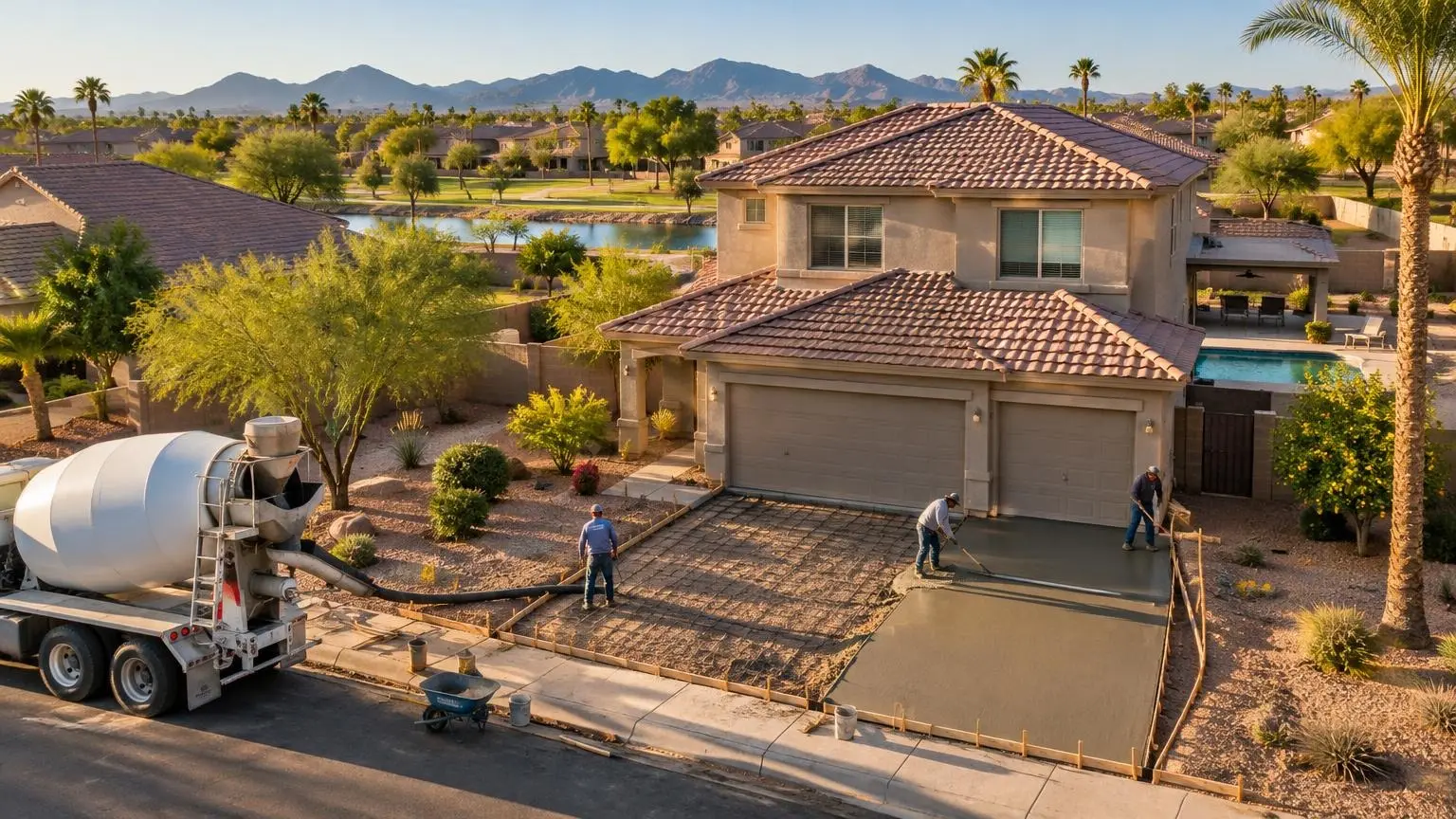
111 days a year at 100°F or hotter
Concrete Contractors in Phoenix, AZ
Driveway, patio and pool deck work on Phoenix homes of every era, planned around the heat.
- Free estimate with a site visit, measurements and a check of slope and drainage
- Written quote listing thickness, base, reinforcement, finish and joints
- Pour times and curing planned around East Valley heat
Phoenix Concrete, Planned for Heat
Any concrete contractor working in Phoenix has to plan pours around the heat. Wikipedia counts an average of 111 days a year that reach 100 degrees, and roughly 21 that pass 110; the city's record, 122 degrees, was set on June 26, 1990. We serve homeowners on the east side of Phoenix, nearest the East Valley, with the same driveway, patio, pool deck, slab and repair work we do in Gilbert.
Why heat changes the job
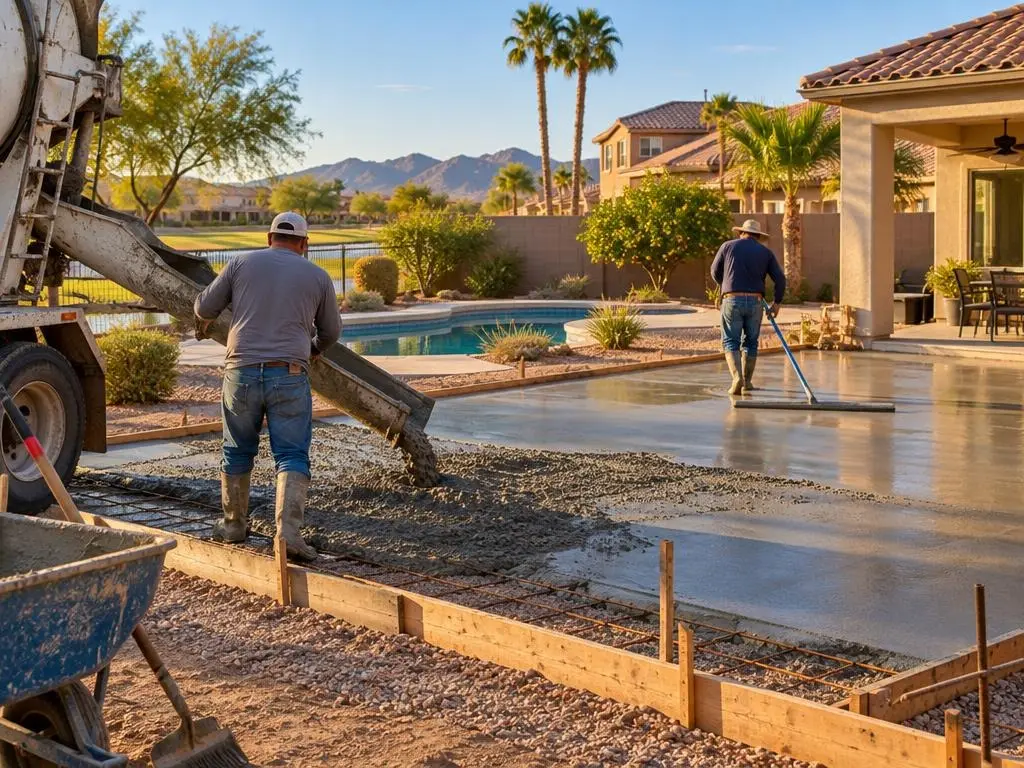
Cement hardens through a reaction with water. In Phoenix heat, the top of a slab can dry before that reaction is far along, leaving a soft, powdery surface and extra shrinkage cracks. Our summer routine:
- Trucks booked at sunrise so finishing wraps up before midday
- Subgrade and forms wetted down beforehand
- Enough hands on site to place and finish without delay
- Curing compound or wet curing right behind the finishers
- Joints sawn the same day, not left until the next afternoon
None of this costs much, and all of it shows in how the slab wears.
Homes of every age
Phoenix went from 106,818 residents in 1950 to 439,170 ten years later, and Wikipedia notes that more was built in 1959 alone than in the years 1914 through 1946 combined. Point2Homes' Census summary gives a median construction year of 1985, with 18.6% of homes from the 1970s and 17.3% from the 1980s; about 59.8% are detached houses. Postwar ranch homes often need their original walks and narrow drives replaced, 1980s and 1990s homes need repair and expansion, and newer homes mostly want extensions and decorative work.
Monsoon season
The National Weather Service has used June 15 through September 30 as the Phoenix monsoon window since 2008. Sky Harbor's yearly average is only about 7.22 inches of rain, yet a single storm can drop a big share of it. Concrete that tilts toward the house sends that water to the foundation, so every slab we pour is pitched away from the walls and kept clear of side-yard drainage paths.
Permits in Phoenix
Patio covers appear on the City of Phoenix Planning and Development Department's list of residential projects that require a permit. So if a new patio comes with a cover on footings, the cover needs one. For driveways and other flatwork, especially anything touching the street or sidewalk, we check the city's requirements before scheduling.
Dust on pour day
Monsoon storms in the Phoenix area can raise walls of dust, and Wikipedia notes that in some years they reach the scale of a haboob. Wind and grit are a problem for a slab that is still being finished: dust pits the surface, and wind speeds up drying. When a storm is forecast for the afternoon, we finish early or move the pour, and fresh concrete gets covered or cured before the weather turns. Sealing waits until the surface is clean and fully dry.
Heat that stays after dark
Wikipedia's Phoenix article explains that pavement, sidewalks and buildings soak up the day's sun and give it back at night, so the city cools off far less than open desert. The normal daily low stays at 80 degrees or higher for about 74 days each summer. For a new slab, that means no cool night to recover in: curing has to start right away and continue, not stop at sunset. It is also why light-colored, shaded concrete makes a noticeable difference on a Phoenix patio.
What we pour in Phoenix
Concrete driveways, patios, stamped concrete, pool decks, slabs for sheds and RVs, and concrete repair. Call (480) 351-1697 for a written estimate.
Phoenix Facts
- Extreme heat. Wikipedia counts about 111 days a year at 100°F or more and roughly 21 above 110°F; the record is 122°F (June 26, 1990).
- Warm nights. The normal daily low stays at or above 80°F for about 74 days per summer, because pavement and buildings release stored heat at night.
- Postwar boom. Population rose from 106,818 in 1950 to 439,170 in 1960, and more was built in 1959 than in 1914 through 1946.
- Patio cover permits. The city's Planning and Development Department lists patio covers among residential projects that require a permit.
Our Services in Phoenix, AZ
Phoenix Questions
What time of day do you pour concrete in Phoenix summers?
As early as there is light to work. Finishing is done before the worst of the heat, and the slab gets cured right away.
Does a covered patio need a permit in Phoenix?
The city lists patio covers as needing a permit. We check what applies to the slab and the cover and plan the schedule around it.
Which parts of Phoenix do you serve?
Mainly the east side closest to the East Valley. Call with your address and we will tell you if we can get there.
Concrete Contractors Near Phoenix
- Concrete Contractors in Gilbert, AZ
- Concrete Contractors in Mesa, AZ
- Concrete Contractors in Chandler, AZ
- Concrete Contractors in Queen Creek, AZ
- Concrete Contractors in San Tan Valley, AZ
- Concrete Contractors in Higley, AZ
- Concrete Contractors in Tempe, AZ
- Concrete Contractors in Scottsdale, AZ
- Concrete Contractors in Ahwatukee, AZ
- Concrete Contractors in Apache Junction, AZ
- Concrete Contractors in Gold Canyon, AZ
- Concrete Contractors in Sun Lakes, AZ
- Concrete Contractors in Maricopa, AZ
- Concrete Contractors in Fountain Hills, AZ
- Concrete Contractors in Agritopia, AZ
- Concrete Contractors in Lehi, AZ
- Concrete Contractors in Leisure World, AZ
- Concrete Contractors in Guadalupe, AZ
- Concrete Contractors in Paradise Valley, AZ