
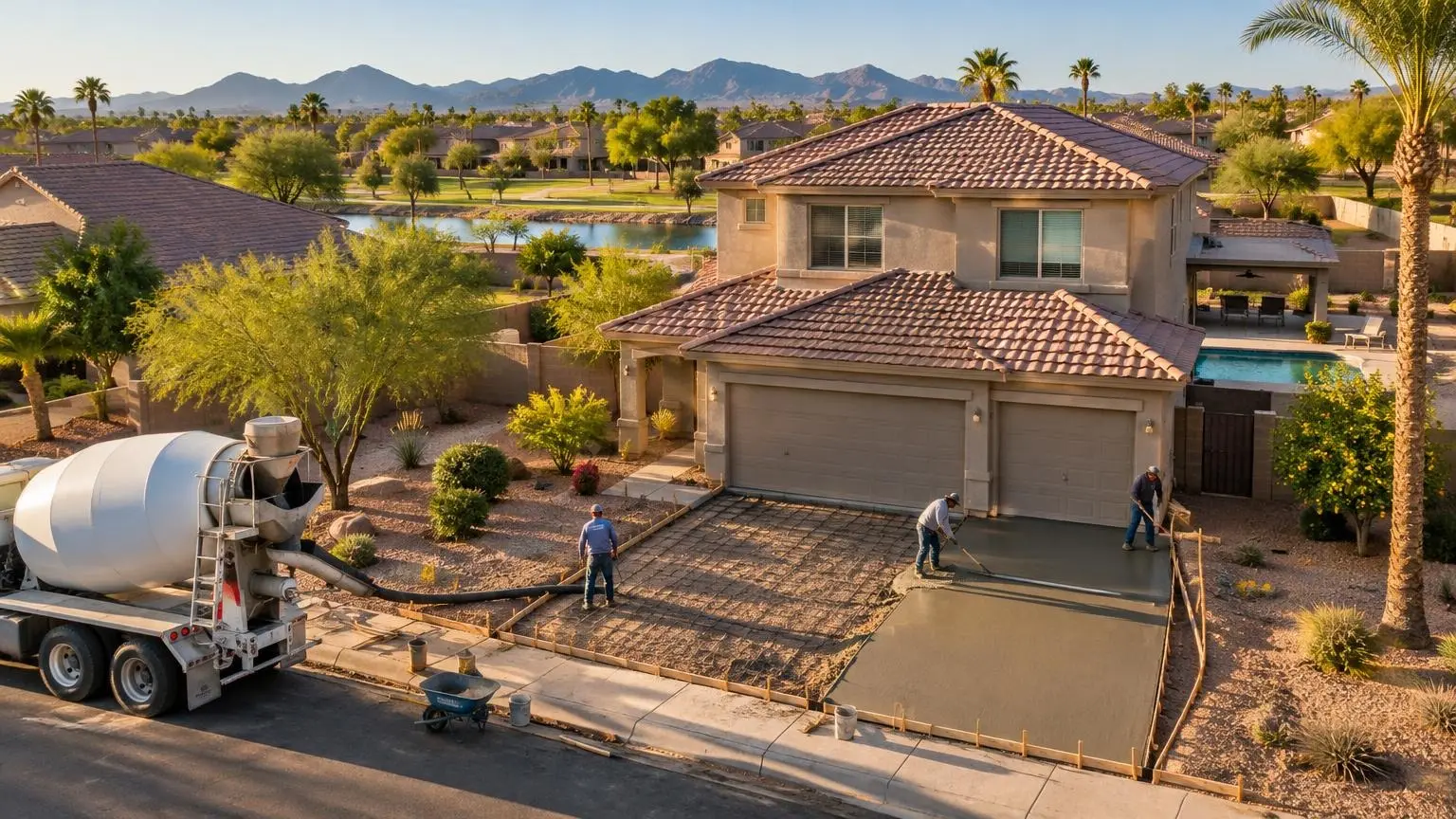
Half the town's homes went up after 2000
Concrete Contractors in Gilbert, AZ
Driveways, patios, pool decks and repairs for a town that grew from 5,717 residents in 1980 to 267,918 in 2020.
- Free estimate with a site visit, measurements and a check of slope and drainage
- Written quote listing thickness, base, reinforcement, finish and joints
- Pour times and curing planned around East Valley heat
Concrete Work Across Gilbert
Most requests Gilbert concrete contractors get involve homes somewhere between 10 and 35 years old. Census figures summarized by Point2Homes put the town's median construction year at 2003. About 26.8% of Gilbert homes were built in the 1990s, 35.2% in the 2000s and 21.2% in the 2010s. Fewer than 1 in 20 predates 1980. That means the original builder concrete on a typical Gilbert lot has been through one to three decades of desert summers, and the driveway, the back patio and the pool deck are often the first parts of the house that show it.
Why the age of the housing matters
A slab poured in 2003 is not old by concrete standards, but it has carried cars every day for more than twenty years. The most common issues on Gilbert driveways of that age are hairline shrinkage cracks that have widened, a sunken panel near the garage where the soil under it was never compacted well, and oil stains that soaked into unsealed concrete. Backyards tell a similar story. Builder patios were usually a plain broom-finished rectangle sized for a small table, and many owners now want something larger, a shade structure on footings, or a pool deck that does not burn bare feet.
We look at the existing slab first. If it is sound, an extension that ties in with dowels or a new stamped section can make sense. If it has settled or cracked through, replacing the panel costs less trouble in the long run than patching it every few years.
Desert heat and the pour schedule
Gilbert has a hot arid climate. Wikipedia's climate table lists a mean July high of 106 degrees and a record of 119. Concrete that sets in that kind of heat loses water fast, which can mean a weak, dusty surface and more cracking. In summer we start pours at first light, dampen the base so it does not pull water from the mix, and get a curing compound or wet cure on the slab as soon as finishing allows. Annual rainfall averages about 9.21 inches, a bit more than Phoenix, and much of it comes in short storms, so slope away from the house matters as much as strength.
Lots that hold their own stormwater
Many Gilbert subdivisions were designed so each lot keeps part of its own storm runoff. The Town's checklist for residential additions and accessory buildings (revised 1/2020) requires a site grading and drainage plan on lots that need on-lot retention, tells owners to check the subdivision list or the Gilbert Engineering Division to confirm whether that applies, and says a plan for a property in a flood plain must be sealed by a registrant. Plain flatwork is not always covered by that checklist, but the logic carries over: a bigger patio or a wider driveway must not fill a retention low spot or push water at the neighbor. We map where the yard drains today and keep that route open.
What Gilbert homeowners ask us to build
- Concrete driveways: replacing cracked or sunken panels, widening for a third car, and adding a side pad for a trailer or boat
- Concrete patios: extending the small builder patio and pouring footings for a shade structure
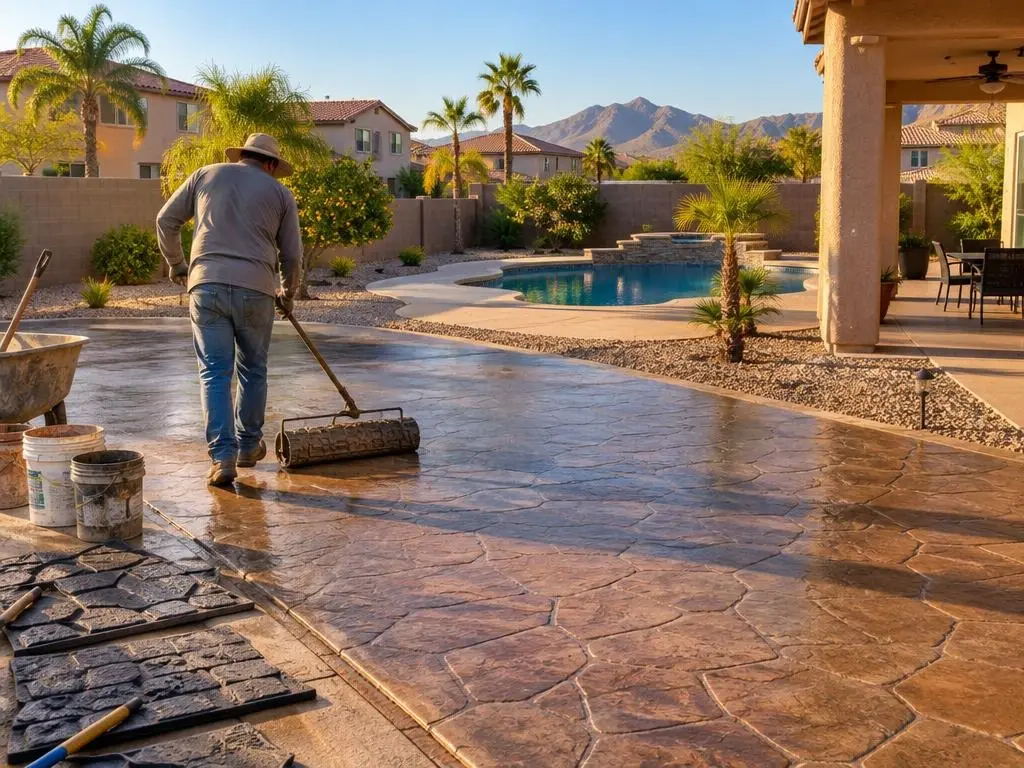
- Stamped concrete: patterns and color on a patio, a front walk or a driveway border, sealed for sun
- Pool decks: new decks and replacement of cracked or heaved decking with a cooler, textured finish
- Concrete slabs: pads for sheds, AC units, sport courts and RV parking
- Concrete repair: crack repair, resurfacing and replacing single panels that have settled
The Town is enforcing the 2018 International Residential Code with Town amendments, according to the same checklist. When a project includes a structure, such as a covered patio on new footings, we check what the Town requires before we schedule the pour.
Digging in Gilbert soil
The Eastern and Consolidated canals and the farm fields they fed shaped early Gilbert, and many subdivisions sit on old agricultural ground. Soil varies from lot to lot. In parts of the Sonoran Desert, crews also run into caliche, a hard calcium carbonate layer that can range from a few inches to several feet thick and that blocks drainage. We dig test spots for footings and compact the base in lifts so the new concrete does not sit on loose fill. If we hit caliche, we tell you before we change the plan.
Two generations of Gilbert concrete
Because about a fifth of the town's homes went up in the 2010s while a quarter date from the 1990s, two very different jobs share the same zip codes. On 1990s lots the work is mostly corrective: replacing panels that have dropped, cutting out cracked aprons and reworking patios that slope the wrong way. On 2010s lots the slabs are usually sound but small, so the work is additive: a wider drive, a bigger back patio, a pad by the side gate. We price both the same way, with the thickness, reinforcement, finish and joint layout written out. Call (480) 351-1697 to set a time.
What to Know in Gilbert
- Housing age. The median Gilbert home was built in 2003. Homes from the 1990s, 2000s and 2010s make up about 83% of the stock, and pre-1980 homes are under 5% (Point2Homes summary of Census ACS data).
- Rapid growth. Gilbert had 5,717 residents in 1980, 109,697 in 2000 and 267,918 in 2020, with 93,230 housing units counted in the 2020 census.
- On-lot retention. The Town's residential additions checklist (rev. 1/2020) calls for a grading and drainage plan on lots that require on-lot retention, confirmed through the subdivision list or the Engineering Division.
- Climate. Gilbert's July mean high is 106°F with a record of 119°F. Average yearly rainfall is about 9.21 inches, slightly more than Phoenix.
Our Services in Gilbert, AZ
Gilbert Questions
Do I need a permit to replace my driveway in Gilbert?
It depends on the scope, especially if the work reaches the sidewalk, the street or a retention area. We check with the Town of Gilbert before we schedule and tell you what applies. Your HOA may also need to approve the design.
Can you pour concrete in Gilbert in July?
Yes. We start very early in the morning, dampen the base, and cure the slab right after finishing so it does not dry out too fast. Hot-weather planning is part of every summer pour here.
My builder patio is too small. Can you add onto it?
Usually. If the existing slab is level and not cracked through, we can extend it and tie the new section in with dowels. If it has settled, replacing it may give a better result.
Free Estimates in Gilbert, AZ
Free on-site estimates anywhere in Gilbert.
Concrete Contractors Near Gilbert
- Concrete Contractors in Mesa, AZ
- Concrete Contractors in Chandler, AZ
- Concrete Contractors in Queen Creek, AZ
- Concrete Contractors in San Tan Valley, AZ
- Concrete Contractors in Higley, AZ
- Concrete Contractors in Tempe, AZ
- Concrete Contractors in Scottsdale, AZ
- Concrete Contractors in Phoenix, AZ
- Concrete Contractors in Ahwatukee, AZ
- Concrete Contractors in Apache Junction, AZ
- Concrete Contractors in Gold Canyon, AZ
- Concrete Contractors in Sun Lakes, AZ
- Concrete Contractors in Maricopa, AZ
- Concrete Contractors in Fountain Hills, AZ
- Concrete Contractors in Agritopia, AZ
- Concrete Contractors in Lehi, AZ
- Concrete Contractors in Leisure World, AZ
- Concrete Contractors in Guadalupe, AZ
- Concrete Contractors in Paradise Valley, AZ